Call for Papers: Seeing with Touch: Images After Gaza. Re-visiones Journal, Vol. 16, No. 2 (Autumn 2026)
Re-visiones Journal, Vol. 16, No. 2 (Autumn 2026)
Guest Editor: Kinda Youssef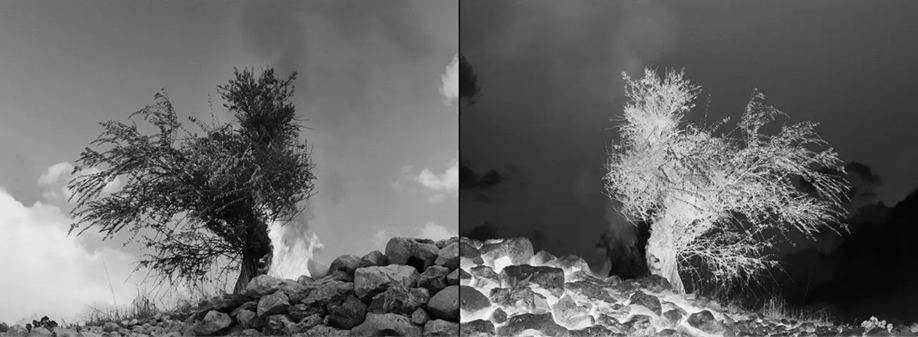
Larissa Sansour, Bethlehem #15 (2012), from the series Nation Estate. Courtesy of the artist and Lawrie Shabibi Gallery, Dubai.
Since 2011, I have maintained an ambivalent relationship with images. I left my country, Syria, when violence began to intensify, and I have not returned since. The place was reduced to a screen —a tactile territory where looking became a form of mourning. For years, I repeated the same gesture: sliding my finger over images until the body —and the gaze— grew weary. With the genocide in Gaza, that ritual returned. I go online, I look, I escape, I look again. I recall Aurora Fernández Polanco’s reading of The Incredulity of Saint Thomas by Caravaggio: that act of “seeing with touch” that guides the gaze toward the wound. Perhaps looking today means precisely that: holding one’s finger on the burning surface of the image —not to believe, but to remain with the pain that persists, and from it, to learn how to know, to think, and to research what images still demand from us.
To think the image after Gaza is to inhabit the tension between total exposure and erasure —between visual overproduction and the disappearance of the body. Gaza is not a distant event but a condensation point of the world, a symptom of the contemporary polycrisis where settler colonialism, fossil modernity, ecological collapse, and the erosion of post–World War II humanitarian and legal frameworks converge. In Gaza, genocide emerges as an unrestrained expression of capitalist power over life and nature. Within this uncertain terrain, vision becomes a battlefield, and the gaze, an exhausted witness that nonetheless perseveres.
Ariella Aïsha Azoulay proposes understanding photography as a civil contract between those who appear, those who record, and those who look. The images emerging from Gaza do not seek compassion but shared responsibility. Looking is not a neutral act: it is a political practice. Each deleted image constitutes a form of administrative violence; each fragment that reappears, a gesture of insubordination against the algorithm. As Judith Butler reminds us, visual frames determine which lives —and which images— are deemed grievable. The restitution of the image thus becomes an ethical gesture toward those dispossessed of their own visibility within a predatory regime of documentation. In the works of Basel Abbas and Ruanne Abou-Rahme, this restitution takes the form of fragment, error, and interruption: the image fractures and remakes itself, insisting on appearing.
Harun Farocki once described certain images as operative: not made to be seen, but to function, to calculate, to kill. We now inhabit that machinic vision in which drones, satellites, algorithms —and the montages fabricated by hegemonic media— produce reality rather than record it. Yet even within this regime of control, the image can crack, letting a shadow —a leak— slip through the transparency of power.
That machinic vision also has its materiality. As Jussi Parikka notes, every visual infrastructure depends on a material economy of energy, heat, and extraction. The image burns; it is part of the same cycle of combustion that fuels the war machine. In this sense, Gaza condenses the continuity between military devastation and ecological exhaustion —what Adrià Rodríguez, following Jason W. Moore, calls the “capitalism of cheap nature”: a system that turns the depletion of life, matter, and memory into the condition of its own perpetuation.
But exhaustion is not only material. The challenge lies not merely in the images themselves, but in what they provoke within us. We inhabit a perceptual exhaustion: truth erodes, empathy thins, meaning dissolves. It is not a crisis of representation, but a crisis of sensibility. From Gaza —writes Muhammad Shehada— not only has the city collapsed, but language itself; the words that once named the world can no longer bear its weight. In that void, the image remains suspended —not as a substitute for language, but as its remainder. Among the ruins, it is what insists on staying when words fail.
This issue of Re-visiones invites contributions that approach the image as a field of forces —political, technical, and affective— in times of extermination and ruin. To see with touch means to sustain attention on what still breathes, to maintain contact with what is crumbling, and to resist the incessant flow of images that feed oblivion. Because the uninterrupted broadcasting of genocide is also to prolong it: to lock us within the eternal present of neoliberalism. To look, then, not to flee, but to interrupt its continuity.
- Visual genealogies of colonialism in Palestine —and beyond— and their continuities in contemporary technologies of surveillance and control.
- Artistic and narrative strategies from diaspora and exile that destabilize hegemonic visual regimes and reconfigure the notion of testimony.
- Visual ecologies: links between image, fossil energy, and environmental devastation.
- Machinic imagination and the technopolitics of vision: algorithms, artificial intelligence, and warfare.
- Politics of the archive and countervisuality in the age of algorithmic censorship.
- Aesthetics of error, opacity, and interference as gestures of resistance.
- Reactions and contradictions in the art field: from censorship and silencing to the creation of networks of solidarity and mutual support.
- Comparative perspectives and controversies around images of violence and genocide: echoes, silences, and resonances across historical contexts.
- Mourning, saturation, and perceptual exhaustion in the contemporary infosphere —and their counterpart: ethics of the gaze, tact, care, and mutual responsibility.
Deadline for submissions: February 9, 2026
Maximum length: 5,500 words (excluding notes and bibliography, strict limit)
Submission guidelines: http://www.re-visiones.net/index.php/RE-VISIONES/pages/view/normas







