Of interest

Call for Papers | After the Journal? Rethinking the Future of Scholarly Publishing

Teknokultura. Revista de Cultura Digital y Movimientos Sociales invites submissions of research articles and video essays for its forthcoming thematic issue, "After the Journal? Rethinking Scholarly Communication", Vol. 25, No. 1 (January–June 2028). Submissions will be accepted on a rolling basis until 15 July 2027, with contributions published as soon as they have successfully completed the editorial process.

This thematic issue invites scholars and publishing professionals to critically reconsider the present and future of academic journals, exploring their evolving roles, models of peer review and publication, institutional infrastructures, governance arrangements, and possibilities for transformation. We particularly welcome contributions examining the implications of Open Science, artificial intelligence, the sustainability of scholarly communication, persistent inequalities in the production and circulation of knowledge, and emerging alternatives to established publishing models.

The full Call for Papers, including the scope of the thematic issue and submission guidelines, is available on the Teknokultura website.

For further information or enquiries, please contact secretaria@teknokultura.net.
Teknokultura Statement Against the Invasion of Venezuela

From Teknokultura. Journal of Digital Culture and Social Movements, we express our strong opposition to the invasion carried out by the United States against Venezuela. This military action violates international law and the principle of self-determination and deepens a pattern of geopolitical control and resource extraction that recalls long-standing colonial violence in Latin America, now articulated through an openly imperial rhetoric.

Our condemnation of this aggression does not imply support for the Maduro government. Defending Venezuelan sovereignty means affirming that it is for the Venezuelan people alone to decide their forms of political organization and to address their internal conflicts, without military interference or economic pressure from foreign powers.

In the face of invasion and looting, we reaffirm the urgent need for internationalist resistance and solidarity in defense of life, territory, and the dignity of people. As a collective working at the intersection of sociology, political science, communication, and critical technology studies, we call on academics, activists, journalists, digital culture workers, and social movements to build networks of international solidarity with the Venezuelan people and to denounce this intervention across spaces of research, teaching, and public debate.

Editorial Team, Teknokultura


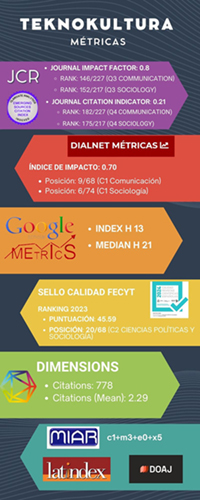
Teknokultura alcanza posiciones destacadas en Dialnet y FECYT, y mantiene el Sello de Buenas Prácticas Editoriales en Igualdad de Género

En Teknokultura estamos orgullosos/as de anunciar que hemos logrado avances importantes en la indexación y en el reconocimiento de nuestras prácticas editoriales. Gracias al esfuerzo de nuestro equipo editorial, revisores/as y lectoras/es, hemos conseguido:

  • Q1 en Dialnet Métricas (Sociología; Comunicación) 
  • Q2 en el Ranking FECYT (Ciencias Políticas y Sociología)

Además, hemos recibido el Sello de Buenas Prácticas Editoriales en Igualdad de Género, un reconocimiento que refleja nuestro compromiso con la equidad y la diversidad. Este sello premia a las revistas que:

  • Mantienen un equilibrio de género en los equipos editoriales y de revisión.
  • Visibilizan a las autoras en los listados de referencias.
  • Cuidan el uso de lenguaje inclusivo.
  • Consideran la variable de género en sus investigaciones.

Adjuntamos una infografía que resume estos y otros logros recientes de la revista. Agradecemos a toda la comunidad que apoya y confía en Teknokultura, y seguimos trabajando para mantener estos altos estándares.

Atentamente,
El equipo editorial 

Teknokultura’s Statement in Support of Academic BDS and Against the Genocide in Palestine

As a journal committed to critical thinking and social justice, Teknokultura stands in solidarity with the Boycott, Divestment, Sanctions (BDS) movement against Israeli academic institutions. These universities are not neutral spaces of knowledge; they are key pillars of apartheid, settler colonialism, and the genocide Israel is waging against the Palestinian people. Their deep entanglement with the Israeli state’s military and political apparatus has been extensively documented, revealing their role in legitimizing and perpetuating occupation and systemic oppression. In line with the call from Palestinian organizations, Teknokultura 

commits to refusing publication, peer review, arbitration, or advisory roles for submissions affiliated with Israeli universities.  We will not accept submissions from authors who list an Israeli university as their institutional affiliation. The only exceptions will be works associated with Israeli institutions that explicitly advocate for human rights and oppose the occupation of Palestinian territories—such as B’Tselem (a human rights organization) or The Refuser Network (a radical anti-occupation collective)—or those signed solely with the authors' names, omitting any mention of an Israeli university. Likewise, we will not request peer reviews or any form of academic engagement from researchers affiliated with Israeli academic institutions. Teknokultura reaffirms its commitment to producing knowledge that does not serve as a tool of genocide. We refuse to remain indifferent or to normalize violence. We call on the academic community to take a principled stance, to challenge the structures of knowledge production that sustain occupation and oppression, and to join the BDS movement as a concrete act of solidarity and resistance.

Editorial Board, Teknokultura

Current Issue

Vol. 0
Published: 2024-10-17

The documents will be published in this space prior to their final publication (with its layout) as part of one of the monographs, current and/or special issues that you can consult here.

View All Issues