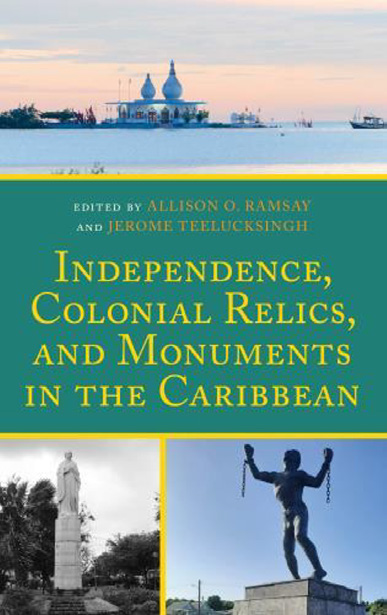
As ongoing discussions attest, the impact of European colonisation of
the Caribbean continues to leave its mark. Allison O. Ramsey and Jerome
Teelucksingh’s edited volume brings together regional scholars to survey
tangible and intangible aspects of this controversial legacy. In its
eleven chapters, the work combines perspectives from historians,
lawyers, sociologists, and cultural heritage experts. Ramsey and
Teelucksingh’s Introduction opens by presenting debates relating to
monuments and their role in history, culture, and memory. Bridget
Brereton analyses the historical, religious, and cultural debates
surrounding the Trinity Cross, once Trinidad & Tobago’s highest
national honour, noting the controversy caused as an ostensible symbol
of a multi-religious nation. Stanley H. Griffin delves into the impact
of George Floyd’s 2020 murder on the Caribbean, examining how it
catalysed discussions on race, national identity, and decolonisation
through case studies of Lord Nelson’s statue in Barbados and the
governor-general’s insignia in Jamaica. Sheron Johnson also highlights
the replacement of the Nelson statue, exploring how esteem has been
attributed to the intangible cultural heritage of Barbados’s capital
Bridgetown. In Trinidad, Ashleigh John Morris delves into the history of
the Five Islands archipelago, formerly the site of a depot used to
process indentured labourers from India and their families on arrival in
the colony. Allison O. Ramsey returns to Barbados, providing an overview
of monuments and their role in public history, noting the lack of
statues of women. Shaian Albert provides detailed case studies of the
creation of three notable Trinidadian Hindu temples, and Margo
Groenewoud examines the intersection of statues and identity in the
colonial Netherlands Antilles between 1940-1960. In underscoring the
dearth of statues and landmarks commemorating women in Trinidad &
Tobago, Danalee Jahgoo outlines the specific case of the St Augustine
campus of the University of the West Indies. In Barbados, Lynette Mills
examines the contentious impact of Christopher Codrington, a slave-owner
and benefactor whose name is still given to a theological college, as
well as the library at All Souls, Oxford. And though most Caribbean
nations became independent decades ago, Timothy Affonso draws attention
to the legal ramifications of colonisation which, in some instances,
still prevails. Finally, Renee A. Nelson sheds lights on how the
ill-fated West Indies Federation influenced Jamaican conceptualisations
of independence and nationhood. In summary, this is an extremely timely
and important volume which offers valuable interdisciplinary
contributions to key debates in the Caribbean context.